Quick answer: The company’s capsule wardrobe is a collection of about 15 to 25 professional outfits curated and put together for every workday scenario. Think tailored blazers, smart trousers, quality blouses and polished shoes. The result is fewer “I have nothing to wear” mornings and a closet full of clothes that all match.
Building a corporate capsule wardrobe changed the way I think about dressing for work. Previously, my closet was full of disheveled office items that never matched. Half my mornings start with frustration and a pile of rejected clothes on the bed.
The fix is simple: stop buying more and start buying smarter. The company’s capsule brings you a small collection of workwear pieces thrown together. Every blazer goes with every pair of trousers. Every blouse fits perfectly under every jacket. If you’ve been exploring the idea of a smart casual capsule wardrobe, this takes the same principles and applies them to the office.
Below, I’ll cover the pieces you’ll need, how to make clothes out of them, and the mistakes most people stumble into when putting together work wardrobe essentials.
Plan your wardrobe budget before shopping. A capsule wardrobe saves money in the long run, but only if you set boundaries up front. Grab a Budget Planner to map out how much you can actually spend on your capsule refresh this season.
The Best Items to Start Your Company Capsule Wardrobe
This is the section I recommend as your starting base. Each item pairs well with almost every other item on this list, meaning fewer items can do more work in your closet.
Recommended Company Wardrobe
What Makes a Corporate Capsule Wardrobe Different from Regular Work Clothes
A typical work wardrobe is just every office item you’ve accumulated. The company’s capsule is strategic. Each item is chosen because it matches at least four or five other items in your closet.
The difference is visible in your morning. With capsules, you can really take almost any combination and come out with a harmonious look. No guesswork, no “does this line up with that?” moment. If you already know how to create a capsule wardrobe for casual wear, the corporate version follows the same logic with slightly more structured cuts.
Most company capsules contain between 15 and 25 pieces, depending on how many days a week you go to the office. If you are in the office for five days, choose 20 to 25 days. Hybrid workers working in two or three days can get 15 solid objects that rotate well.
A Must-Have Foundational Piece for Your Company Capsule
These are the items that do the heavy lifting. Get it right and dressing becomes almost automatic.
Structured Blazers (Two)
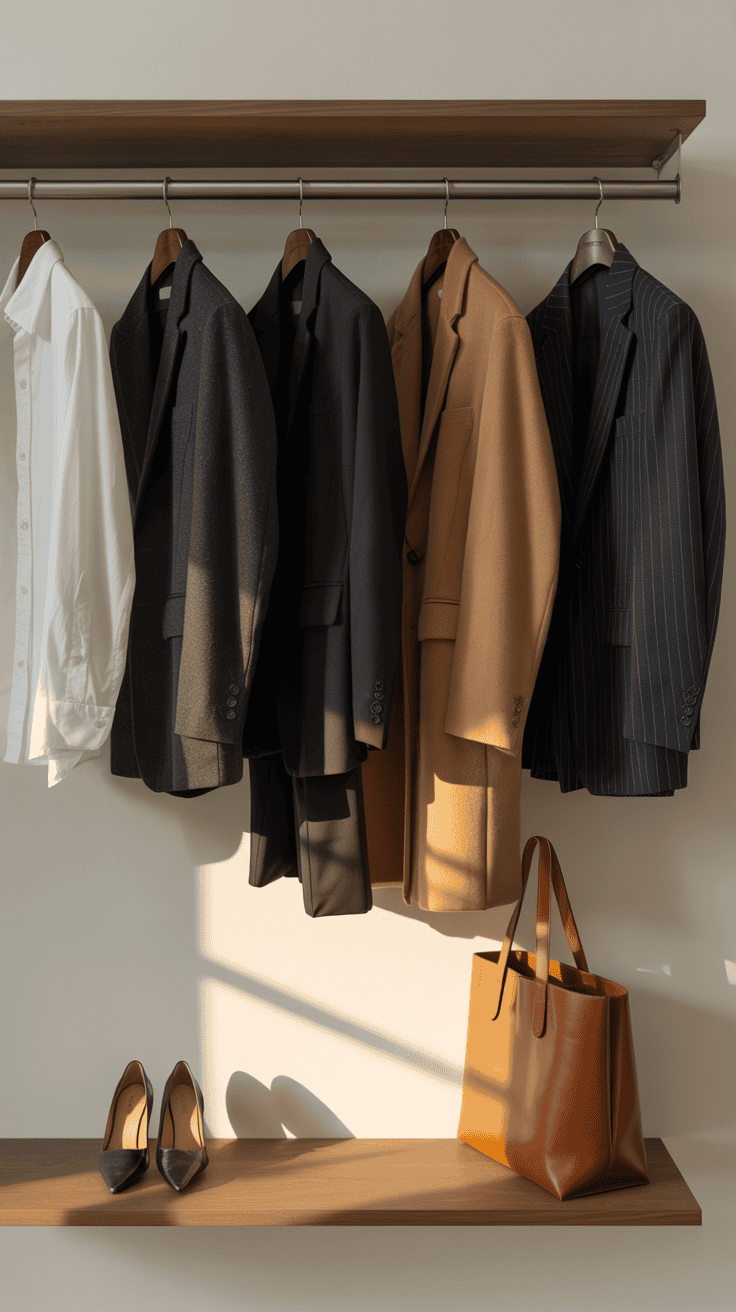
One is black or navy, the other is a lighter neutral color such as camel, gray, or oatmeal. A structured blazer is the single fastest way to make any outfit look professional. Pair it with trousers for a meeting, wear it with a simple dress for a presentation, or wear it with dark jeans on a casual Friday. Look for one that fits at the hip, has one button, and doesn’t pull when you cross your arms.
Custom Trousers (Three Pairs)
Black, charcoal, and one lighter option (brown or light grey). Cuts with straight or slightly wide legs are the most professional today. Avoid clothes that are too tight, too short, or too trendy. These are your everyday work gear, so buy a pair that retains its shape after dry cleaning. A good pair of trousers paired with a blouse and blazer takes care of 80 percent of corporate scenarios.
Classic Blouses and Button Downs
Three to four tops in solid colors: white, cream, light blue, and one muted accent color (dusty rose, sage green, or soft burgundy). Silk or silk-blend blouses look subtle but are still comfortable to wear in a warm office. White crisp cotton buttons are non-negotiable. This top does double duty as it can be worn under a blazer for formal days and paired with trousers for more casual gatherings.
A-Line Pencil or Midi Skirt
One well-fitted skirt in a dark neutral color adds variety to your rotation without taking up much space in your closet. A pencil skirt is appropriate for the traditional office, while an A-line midi feels less formal and more comfortable for sitting in all day. Pair it with a tucked-in blouse and a structured bag, and you’ve got a flawless look that doesn’t require any effort.
How to Build a Week’s Outfit From Your Company Capsule
The true test of a corporate capsule wardrobe is whether you can get through an entire work week without repeating the same outfit. With just the pieces above, here’s what it looks like.
Monday: Black blazer, white button-up, charcoal trousers, pointed-toe flats, structured tote bag. Clean, sharp, ready for anything. Tuesday: Camel blazer, light blue blouse, black trousers, heeled boots. The palette is a little warmer, still professional. Wednesday: Pencil skirt, cream silk blouse, black heels. A different silhouette that breaks up the trouser routine.
Thursday: Knitted sweater tucked into brown trousers, navy blazer thrown over the shoulders, loafers. Relaxing but perfect for weekend energy. Friday: Dark jeans (if your office allows), white button-up, camel blazer rolled up at the sleeves, white sneakers. Casual Friday done right. Five days, five very different looks, all from the same small batch.
Table to Dinner Transition that Actually Works
The promise of a “table for dinner” is usually overblown. Most advice boils down to “just add a statement necklace,” which honestly doesn’t help much. What actually works is swapping out one layer and one accessory.
Take your daytime clothes in the form of a blazer, blouse and trousers. Ditch the blazer, swap out a structured tote for a smaller crossbody bag or clutch, and switch from flats to heeled boots or strappy sandals. That is it. Two changes, very different energies. If your blouse is silk or has interesting details (a subtle print, a draped neckline, interesting sleeves), it can still be worn without a blazer.
The reason this works better than accessories alone is because removing one layer will change your silhouette. Tailored blazers create a structured, boxy shape. Without it, a tucked-in blouse shows off your waist and is considered evening-ready. If you’ve created a chic capsule wardrobe, you know that the best pieces can be worn in a variety of contexts like these.
Shoes are another variable. Block-heeled loafers or simple pointed-toe flats are great for wearing at the office all day. Switch to slightly higher heels or strappy sandals in the evening and the outfit will change completely. Keep a pair of evening shoes under your table if dinner is a regular occurrence. It takes thirty seconds and it really works.
Corporate Mistakes That Make You Look Like You’re Trying Too Hard
Buying too many prints. One patterned blouse or one patterned skirt is enough for a full capsule. Prints are harder to mix and match, and too many prints will make your closet feel chaotic instead of curated. Use solids for 80 to 90 percent of your work and let one or two prints be your statement items.
Ignore the quality of the fabric. In a corporate environment, fabric shows are cheap. Peeling polyester, creased cotton at 10am, lots of layers. You don’t have to spend a lot of money, but prioritize natural fibers (cotton, wool, silk blends) for your most visible items: blazers, trousers and blouses. Your basic clothing items should always be of the best quality you can afford.
Forget about comfort. Capsules only work if you actually use all the contents. That pretty pencil skirt won’t do you any good if it rides up every time you sit down. Those heels will be a huge burden if they damage your feet during the day. Try them all, sit in them, walk in them, raise your hand. If it fails the comfort test, it fails the capsule test.
It doesn’t take into account your actual office culture. The corporate capsule for a law firm looks very different from that of a tech startup that calls itself “corporate.” Read the room before building your capsule. If everyone around you is wearing jeans and sneakers, wearing a pencil skirt and pointy heels means you’ll always feel overdressed.
Track your capsule wardrobe expenses. Knowing exactly where your money goes makes it easier to invest in quality over quantity. Savings Tracker helps you stay on top of your wardrobe budget from month to month.
Frequently Asked Questions About Corporate Capsule Closets
How many items do I need for a corporate capsule wardrobe?
Most people find that 15 to 25 pieces of clothing can cover a full work week comfortably, including blazers, slacks, blouses, skirts, and a few layering options. The exact amount depends on how often you wash clothes and whether your office tends to be formal or casual.
Can a corporate capsule wardrobe work in a business casual office?
Very. A smart casual capsule wardrobe follows the same principles with slightly more relaxed cuts. Swap the structured blazer for an unstructured one, swap the pencil skirt for wide-legged pants, and you’re all set.
What colors are most suitable for a corporate capsule?
Choose neutral basic colors of black, dark blue, charcoal, and white or cream. Then add an accent color or two that complements your skin tone. This makes everything interchangeable while still showing your personality.
How often should I update my company capsule wardrobe?
Review every six months. Replace anything that is worn, bunched, or no longer fits. Most people add two to three new pieces of clothing per season and discontinue an equal number, keeping their wardrobe fresh without starting from scratch.
Important Points
- The company’s capsule wardrobe works because each piece combines with many others, reducing morning decision fatigue to almost nothing.
- Start with a neutral base (blazer, trousers, blouse) before adding any color accents or prints.
- Fifteen to twenty-five pieces is enough to create a non-repetitive wardrobe for a full week for most office environments.
- Fabric quality is more important than brand name in corporate environments where cheap materials are immediately apparent.
- Review and refresh your capsule every six months, replacing outdated items and adding two to three seasonal updates.
Final Thoughts
The company’s capsule wardrobe isn’t about wearing the same clothes every day. It’s about wearing Right things in different combinations so that getting dressed for work feels easy and not tiring.
Start small. Choose five foundations that you already own that fit and feel comfortable. Build from there, adding one at a time until every item in your wardrobe can be combined with at least three other items. That’s when you’ll notice a real change, not only in the morning, but also in the way you carry yourself at the office.
The best office capsule wardrobe is one you actually use. So keep it simple, keep it intentional, and stop overthinking.
PakarPBN
A Private Blog Network (PBN) is a collection of websites that are controlled by a single individual or organization and used primarily to build backlinks to a “money site” in order to influence its ranking in search engines such as Google. The core idea behind a PBN is based on the importance of backlinks in Google’s ranking algorithm. Since Google views backlinks as signals of authority and trust, some website owners attempt to artificially create these signals through a controlled network of sites.
In a typical PBN setup, the owner acquires expired or aged domains that already have existing authority, backlinks, and history. These domains are rebuilt with new content and hosted separately, often using different IP addresses, hosting providers, themes, and ownership details to make them appear unrelated. Within the content published on these sites, links are strategically placed that point to the main website the owner wants to rank higher. By doing this, the owner attempts to pass link equity (also known as “link juice”) from the PBN sites to the target website.
The purpose of a PBN is to give the impression that the target website is naturally earning links from multiple independent sources. If done effectively, this can temporarily improve keyword rankings, increase organic visibility, and drive more traffic from search results.