We are very happy to share The results of our fourth study of how to start a web application in 2025!
Our annual research on how web applications have begun have attracted interest and recognition that has increased for four consecutive years. Building on a foundation placed in 2022, 2023, and 2024, we continue our efforts to capture the latest trends, tools and methodologies that shape how web applications are developed.
In 2025, our focus developed to include concepts that emerged such as “vibe coding” and increasing the use of web AI generators. We have improved the survey by removing outdated topics and adding new questions to further reflect the evolution of the fast landscape of web development. As in previous years, we aim to understand how web applications begin in all full spectrums, from traditional coding environment to low/without code platforms and solutions assisted by AI.
This year, we also continue to collect data about the role of respondents, engineers, decision makers, etc., allow us to examine how professional responsibilities influence the development approach and the choice of tools.
The 2025 edition survey was conducted between April and July. As many as 303 participants from 33 countries took part. Below is a detailed review of technology, framework, platforms, and workflows used by users to build web applications today.
Previous year research results:
This year’s results: â

Stated key findings:
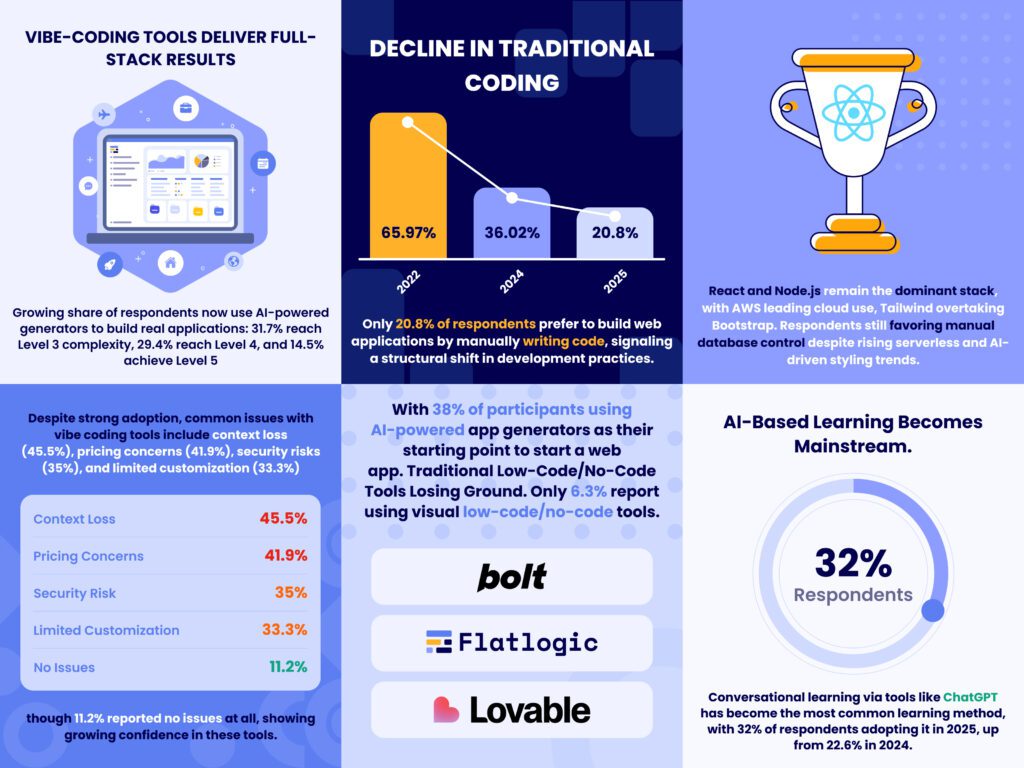
- Decrease in traditional coding: only 20.8% of respondents who prefer to build web applications by writing code manually. This continued the significant decline trend of 36.0% in 2024 and 65.9% in 2022, signifying structural changes in development practices. Although around 40 € “50% of professional software engineers still prefer manual coding
- Tools such as Bolt.new, Flatlogic, and Lovable have become famous, with 38% oF Participants who use AI -powered application generators as their starting point to start web applications. Low code/no-traditional code loss of soil. Only 6.3%Report using a visual low-code/no-code.
- The vibration coding device gives full pile results.The developing parts of respondents now use AI -powered generators to build real applications: 31.7% reached level 3Complexity (Frontend application with backend integration), â 29.4% reached level 4Â (Special Full-Stack Applications with CRUD and Data), and 14.5% reached level 5Saas production level with advanced features. All numbers are reported alone.
- Although strong adoptionCommon problems with vibration coding devices include Loss of context (45.5%)A price problem (41.9%)A Security Risk (35%)and and and Limited customization (33.3%). However, â € 11.2% reported no problem at allDemonstrate self -confidence in these tools.
- React and node.js remains a dominant pile, with AWS leads the use of Cloud DanA Tailwind overtook bootstrap. Respondents still support Manual database control even though the style trends without server and AI-Driven rose.
- AI -based learning becomes the mainstream. Learning conversation through tools such as chatgpt has become the most common learning method, with 32%Respondents adopted him in 2025, up from ” 22.6%Â € in 2024.
To read complete reports, including additional insights and complete research methodologies, please visit this page.
Game Center
Game News
Review Film
Berita Olahraga
Lowongan Kerja
Berita Terkini
Berita Terbaru
Berita Teknologi
Seputar Teknologi
Berita Politik
Resep Masakan
Pendidikan
Berita Terkini
Berita Terkini
Berita Terkini
review anime
Gaming Center
Originally posted 2025-08-11 20:14:49.